Thursday, 6 October 2011

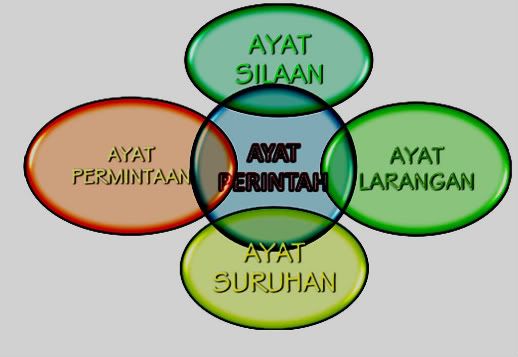
Ayat Larangan

Ayat larangan ialah ayat yang menggunakan kata larangan seperti jangan,usah atau tak usah sebelum kata kerja dengan tujuan menegah seseorang melakukan sesuatu.
  • Jangan ambil harta orang.
  • Usah dikenang lagi kisah yang pahit.
  • Awak tak usah datang lagi ke pejabat.

Ayat tersebut dapat dilembutkan dengan menambahkan partikel –lah , seperti berikut :
  • Janganlah ambil harta orang.
  • Usahlah dikenang lagi kisah yang pahit.
  • Awak tak usahlah datang lagi ke pejabat.

Ada jenis ayat larangan lagi yang bersifat umum yang tidak menggunakan kata larangan dan tidak menerima partikel –lah.
  • Dilarang merokok.
  • Dilarang memancing

Ayat larangan dapat juga dilembutkan dengan menggunakan perkataan harap pada bahagian hadapannya :
  • Harap jangan merokok.
  • Harap jangan berludah.

Ayat Suruhan

Ayat suruhan ialah ayat yang diucapkan dengan tujuan memberi perintah atau arahan.Dalam ayat suruhan subjek ialah kata ganti nama orang kedua seperti awak,kamu,engkau, dan selainnya yang biasanya digugurkan.

Walau bagaimanapun,kerana tujuan penegasan,subjek boleh juga dikekalkan.

  • Pergi kamu dari rumah ini!
  • Engkau tunggu Fateha di sini.

Ayat suruhan boleh menggunakan partikel –lah untuk melembutkannya di samping menegaskan predikat.

  • Pergilah kamu dari rumah ini!
  • Engkau tunggulah Fateha di sini.

Bagi kata kerja transitif yang menerima awalan men-,awalan tersebut perlu digugurkan dalam ayat suruhan jenis ini,seperti dalam ayat di atas .

Dalam binaan ayat suruhan dan ayat perintah jenis lain yang mengandungi kata kerja tak transitif dan menerima awalan, awalan tersebut tidak boleh digugurkan, seperti yang terdapat dalam contoh berikut :

  • Menangislah sepuas-puas hatimu.
  • Berangkatlah dengan segera.

Wednesday, 5 October 2011

Ayat Perintah

Mengikut Tatabahasa Dewan Edisi Baharu, ayat perintah ialah ayat yang diucapkan dengan tujuan untuk menimbulkan sesuatu tindakan. Ayat perintah boleh dibahagikan kepada 4 jenis berikut.

Jenis-Jenis Ayat (BM)

Bahasa Melayu mempunyai berbagai-bagai jenis ayat untuk menyatakan maksud yang sama.
Ciri-ciri ini menyebabkan bahasa Melayu merupakan sebuah bahasa yang sentiasa hidup serta menarik. Jika hanya satu jenis ayat saja yang digunakan akan timbul rasa jemu pada pembaca.
Oleh sebab itu, sasterawan dan penulis yang baik selalu menggunakan jenis-jenis ayat yang lain, sesuai dengan keperluan.

Jenis-jenis ayat bahasa Melayu dapat digolongkan kepada empat ragam:

1. Ayat penyata:

  • Ayat transitif dan ayat intransitif
  • Ayat aktif dan ayat pasif
  • Ayat sungsang
  • Ayat nafi
  • Ayat inti dan ayat gabungan
2. Ayat perintah

3. Ayat tanya


4. Ayat seru

Tuesday, 4 October 2011

Nenek Si Bongkok Tiga


Nenek, nenek,
si bongkok tiga.
Siang mengantuk,
malam berjaga.
Mencari cucu
dimana 'ada.
Nenek ku kahwin
dengan anak raja.

Cucu, cucu
tak dapat lari.
Nenek tua
banyak sakti.
Sekarang nenek
nak cari ganti.
Siapa kena,
dia yang 'jadi.

Monday, 3 October 2011

Difficult Behaviors in Classroom

1.Rambling -- wandering around and off the subject. Using far-fetched examples or analogies.

POSSIBLE RESPONSES:

Refocus attention by restating relevant point.
Direct questions to group that is back on the subject
Ask how topic relates to current topic being discussed.
Use visual aids, begin to write on board, turn on overhead projector.
Say: "Would you summarize your main point please?" or "Are you asking...?"

2.Shyness or Silence -- lack of participation.

POSSIBLE RESPONSES:

Change teaching strategies from group discussion to individual written exercises or a videotape
Give strong positive reinforcement for any contribution.
Involve by directly asking him/her a question.
Make eye contact.
Appoint to be small group leader.

3.Talkativeness -- knowing everything, manipulation, chronic whining.

POSSIBLE RESPONSES:

Acknowledge comments made.
Give limited time to express viewpoint or feelings, and then move on.
Make eye contact with another participant and move toward that person.
Give the person individual attention during breaks.
Say: "That's an interesting point. Now let's see what other other people think."

4.Sharpshooting -- trying to shoot you down or trip you up.

POSSIBLE RESPONSES:

Admit that you do not know the answer and redirect the question the group or the individual who asked it.
Acknowledge that this is a joint learning experience.
Ignore the behavior.


5.Heckling/Arguing -- disagreeing with everything you say; making personal attacks.

POSSIBLE RESPONSES:

Redirect question to group or supportive individuals.
Recognize participant's feelings and move one.
Acknowledge positive points.
Say: "I appreciate your comments, but I'd like to hear from others," or "It looks like we disagree."


6.Grandstanding -- getting caught up in one's own agenda or thoughts to the detriment of other learners.

POSSIBLE RESPONSES:

Say: "You are entitled to your opinion, belief or feelings, but now it's time we moved on to the next subject," or "Can you restate that as a question?" or "We'd like to hear more about that if there is time after the presentation."


7.Overt Hostility/Resistance -- angry, belligerent, combative behavior.

POSSIBLE RESPONSES:

Hostility can be a mask for fear. Reframe hostility as fear to depersonalize it.
Respond to fear, not hostility.
Remain calm and polite. Keep your temper in check.
Don't disagree, but build on or around what has been said.
Move closer to the hostile person, maintain eye contact.
Always allow him or her a way to gracefully retreat from the confrontation.
Say: "You seem really angry. Does anyone else feel this way?" Solicit peer pressure.
Do not accept the premise or underlying assumption, if it is false or prejudicial, e.g., "If by "queer" you mean homosexual..."
Allow individual to solve the problem being addressed. He or she may not be able to offer solutions and will sometimes undermine his or her own position.
Ignore behavior.
Talk to him or her privately during a break.
As a last resort, privately ask the individual to leave class for the good of the group.


8.Griping -- maybe legitimate complaining.

POSSIBLE RESPONSES:

Point out that we can't change policy here.
Validate his/her point.
Indicate you'll discuss the problem with the participant privately.
Indicate time pressure.

9.Side Conversations -- may be related to subject or personal. Distracts group members and you.

POSSIBLE RESPONSES:

Don't embarrass talkers.
Ask their opinion on topic being discussed.
Ask talkers if they would like to share their ideas.
Casually move toward those talking.
Make eye contact with them.
Comment on the group (but don't look at them "one-at-a-time").
Standing near the talkers, ask a nea-by participant a question so that the new discussion is near the talkers.
As a last resort, stop and wait.

Saturday, 1 October 2011

Keys for Managing Challenging Student Behaviors

KEYS FOR MANAGING CHALLENGING STUDENT BEHAVIORS

Instead of holding your students with an iron grip, allow them to be themselves until (and unless) their behavior distracts you or others in the class.
When you notice unproductive behavior, nip it in the bud. Otherwise, you send a clear message to the students that it's OK for them to talk while you are talking, etc.
Use classroom management techniques before you become irritated, impatient or upset. We are much more powerful when we are centered, when we like out students, and when we view our students with fondness rather than impatience.
Allow students to save face. When we put students down in front of others, the entire class of students will turn against us.
Do all you can to feel good about yourself and others on a daily basis. Your attitude will come across to your students, so it is important to be in good mental and physical shape.
If, by chance, you feel that you have spoken sharply in an attempt to manager your students, own up to it. "Wow, that sounded harsh. Forgive me!"
Remind yourself: "If teaching were easy, everyone would be doing it." Teaching in front of a classroom full of students can be challenging, but on the other hand, very rewarding!